11 traditional fishing villages in the Algarve
Before the airport opened at Faro in 1965, the Algarve coast lived from the sea. Tuna, sardines and octopus fed the villages and the canning factories. Tourism has changed most of the coast since then, but in these eleven places you can still see boats pulled up on the sand, nets drying on the quay and fish going straight from the market to the grill.
In the west
Salema
A narrow lane runs down to a small beach where fishing boats sit next to the sunbeds. Salema has grown, but slowly, and it still feels like a village. At low tide, dinosaur footprints can be seen on rocks at the eastern end of the beach.
Burgau
Steep cobbled streets, a slipway full of small boats and a beach squeezed between cliffs. Burgau is popular with walkers on the coastal path between Luz and Salema.
Luz
Praia da Luz is now largely residential, but the seafront with its old church and the black rock of the Rocha Negra headland is still lovely in the evening. The walk up the Rocha Negra gives a view of the whole bay towards Lagos.
Around Portimão
Alvor
At the mouth of the Alvor estuary, the old village has a fish market, a riverside boardwalk and grilled fish restaurants on the waterfront. The estuary itself is a wetland rich in birds. Alvor's parish church has a richly carved Manueline doorway, described in our guide to historic churches.
Ferragudo
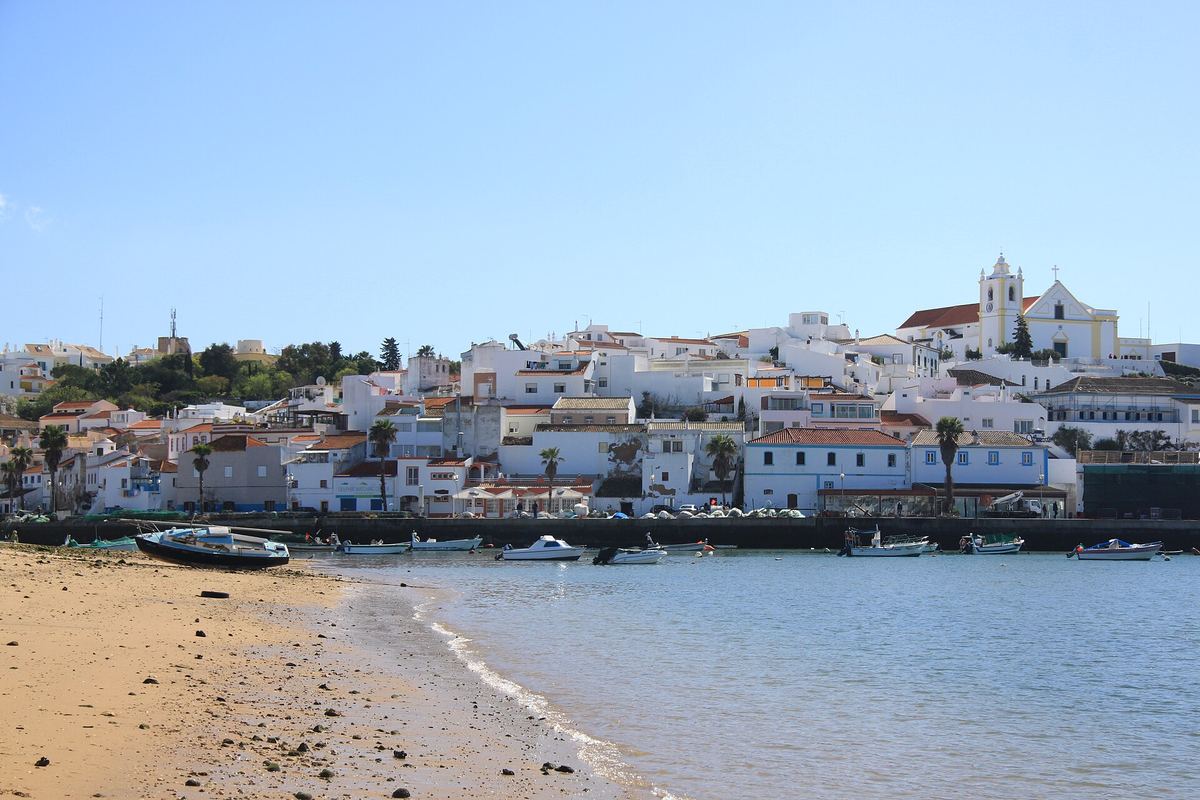
Across the Arade river from Portimão, Ferragudo is often called the prettiest village of the Algarve, and it is hard to argue. White houses climb a hill crowned by a church, the main square opens onto the river, and the waterside restaurants grill sardines on charcoal. The fortress of São João do Arade guards the river mouth.
Carvoeiro
The village beach is still used by fishermen in the mornings, though the surrounding hills are now covered in villas. Carvoeiro makes a good base for the cliffs and grottos of Algar Seco and Benagil.
Benagil
A cluster of houses above a small beach that has become a departure point for cave boats. Come early or late to see the fishing boats rather than the tour queue.
The central coast
Armação de Pêra
A long beach with a fishermen's section at its eastern end, where colourful boats are pulled up near the old fortress chapel. The name "armação" refers to the fixed nets once used to catch tuna.
The east
Fuseta
Fuseta sits on the lagoon, with a fishing harbour, a market and boats to a nearby island beach. It is one of the most authentic villages on the coast and very relaxed outside August.
Santa Luzia
Near Tavira, Santa Luzia calls itself the octopus capital of Portugal. Along the waterfront you see stacks of clay and plastic pots used to catch octopus, and the restaurants serve it grilled, in rice or as salad. Read more in our guide to Algarve seafood dishes.
Cabanas de Tavira
A row of low houses faces the lagoon and the long island beach opposite, reached by a short boat ride. The village is small, the water is calm, and the sunsets over the lagoon are reliable.
Visiting respectfully
These are working places. Don't climb on boats or handle nets. Fish markets are busiest early, usually before ten, and many close on Sundays and Mondays. If you want to taste the catch at its best, plan around the summer seafood festivals, or simply order whatever the restaurant says came in that morning.
 Ten charming coastal towns in the Algarve
 The best seafood festivals in the Algarve
 Surfing in the Algarve: where and when
