Four historical sites in the Algarve worth planning around
The Algarve's name comes from Arabic, al-Gharb, meaning "the west". Romans, Moors and Portuguese navigators all left marks on the region. These four sites tell that story better than any others, and each is easy to combine with a beach or a walk.
1. Silves: the old Moorish capital
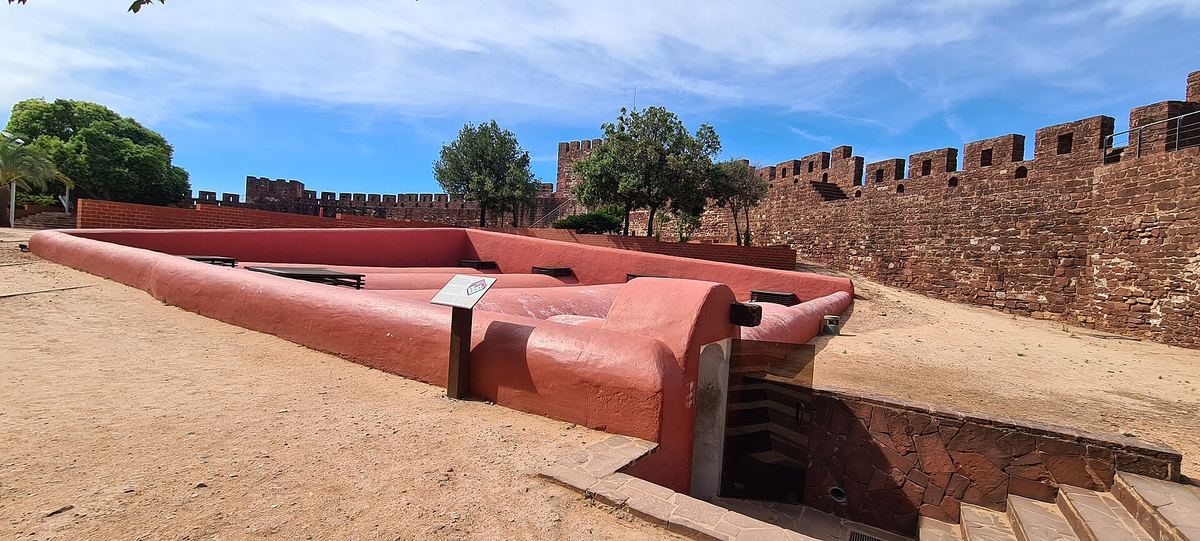
Inland on the Arade river, Silves was the capital of the Algarve under Moorish rule, when it was known as Xelb. Contemporary writers described it as a wealthy city of poets and gardens. Its castle, built of the local red sandstone, is the best-preserved Moorish fortification in Portugal.
Walk the walls for views over orange groves and the river, then visit the cisterns inside. Just below the castle stands the Sé de Silves, the town's Gothic cathedral, built after the Christian reconquest in the thirteenth century. It was the seat of the Algarve's bishops until the see moved to Faro in the sixteenth century. More on the cathedral in our guide to historic churches.
2. Sagres: the edge of the known world
At the far southwestern corner of Portugal, the Fortaleza de Sagres stands on a flat headland surrounded by cliffs. It is closely linked with Prince Henry the Navigator, who supported the voyages of exploration along the African coast in the fifteenth century and lived in the area.
Popular stories speak of a "school of navigation" at Sagres. Historians today are cautious: there was no school in the modern sense, but the prince did gather sailors, mapmakers and shipbuilders around him. The fortress contains a large circle of stones on the ground, often called the wind rose, whose original purpose is still debated. The walk around the headland is spectacular in any case. Nearby, Cabo de São Vicente, with its lighthouse, was considered the end of the world in ancient times.
3. Milreu: a Roman country house
Near the village of Estoi, north of Faro, lie the ruins of Milreu, a large Roman villa occupied from the first century onwards. You can still see the baths, living rooms and mosaics with fish and sea creatures, a reminder that the Romans also lived from the sea here. The tall walls of a temple, later converted into a Christian church, are the most striking part of the site.
4. Lagos: a port with a difficult past
Lagos was one of the main ports of the Portuguese voyages. Its walls, the small fort of Ponta da Bandeira at the harbour entrance and the old town streets are pleasant to wander.
Lagos is also connected to a darker chapter. In 1444, enslaved Africans were brought ashore and sold here, one of the earliest documented slave auctions of the Atlantic slave trade in Europe. The building known as the Mercado de Escravos now houses a museum that explains this history. It is a sober, important visit.
Putting it together
- West: Sagres and Lagos in one day, with a stop at Ponta da Piedade.
- Centre: Silves in the morning, the beaches of Lagoa in the afternoon.
- East: Milreu and Faro's old town, then the lagoon.
Many sites close one day a week, often Monday, and have reduced winter hours. For background reading, the English Wikipedia articles on Silves and Henry the Navigator are a good start.
 Ten historic churches and monasteries in the Algarve
 Traditional Algarve seafood dishes
 Ten charming coastal towns in the Algarve
